Saturday, August 25, 2018

Managing and Identifying the Risks Related to Biochemical Conversion of Waste-to-Energy

The ever-increasing release of greenhouse gas emissions leading to global warming has ignited development of a number of newer technologies for reducing the effect of energy production. One of the technologies emerging for utilization of wastes to generate energy, i.e., produces syngas by gasification to generation heat and power. Energy industries have safety issues relating to steam pressure, combustion, turbines, generators, heat and power distribution are well defined as per standards. The ascent in the quantity of biofuel process plants has brought about various occasions bringing about death toll and property. We have deduced that roughly six to seven fire blast occurrences are accounted for consistently from biodiesel and ethanol enterprises in the India and other countries. The procedure business is very much aware of the money-related dangers and natural risks related with creation and utilizing biofuel as an eco-accommodating option fuel. Be that as it may, restricted data is accessible on the procedure dangers because of the dangers required in the creation of the biofuels. New advancements particularly for refinement, negligible operational involvement with untalented/semi-talented administrators, building and operation of biofuel process plants in hypothetically wrong areas (close to defenseless populaces), require a need to distinguish the procedure perils which bring down the dangers. Overall population organization administrators are not completely mindful of the dangers related with the creation of biofuel. This paper will include the vital perils and necessity of over- seeing procedure hazards in the biofuel business. The discoveries are from hazard examining thinks about led for various sorts of biofuel tasks and biofuel prepare plants.

https://www.springer.com/in/book/9789811071218

http://link.springer.com/10.1007/978-981-10-7122-5

Kinetic parameter evaluation of groundnut shell pyrolysis through use of thermogravimetric analysis

ABSTRAC T

With growing interest in environmentally-friendly sources of energy, biofuel and pyrolysis are increasingly seen as potential solutions. In this study, the pyrolysis of groundnut shell is being investigated, with the intention of determining key kinetic parameters to provide a deeper understanding of the chemical process. A small sample of groundnut shell was pyrolyzed at different heating rates of 10, 20 and 30 K min−1. The thermogravimetric data was used to compare various kinetic models: including a single reaction, consecutive reaction, and dis- tributed activation energy model. The results showed that the consecutive reaction model best described the process when both reactions were set to the second order.

https://doi.org/10.1016/j.jece.2018.07.012

Monday, April 20, 2015

Characterization and Pyrolysis of various Biomass residues

Introduction


Sustainable heat and power generation from biomass are at the center of scientific and industrial interest owing to the increasing awareness of limiting the availability of fossil fuels [1]. Biomass is environmental friendly as well as abundant in nature. 

Combustion of a biomass particle is quite complex as it undergoes various physical and chemical processes including drying, devolatilization/pyrolysis and char burnout [2]. Thus, pyrolysis process is one of unavoidable step during the biomass utilization for heat and power generation and need to investigate carefully at combustion conditions [3].

In the present work, pyrolysis of different biomass is carried out in non-isothermal conditions. Biomass as fuel is currently under research because it has certain major drawbacks. The large varieties of heterogeneous biomass feedstock are available in nature whose properties are required to characterize. The de-polymerization of biomass feedstock results in varieties of different chemical depending upon its composition, can corrode equipment, introducing further reactor design and configuration issues. Nevertheless, depleting fossil fuels are expected to wider use of biomass and the implementation of new technologies and processes.

Characterization of biomass


Physical characterization


Biomass is low in carbon (roughly between 30 wt% to 40 wt% on dry, ash-free basis) and high in volatile matter and oxygen, which result in low calorific values. But significant advantage of biomass with respect to coal is that the contents of nitrogen and especially sulfur are low. Proximate and ultimate analyses of biomass are carried using TGA and CHNOS analyzer respectively. Table 1 proximate analysis and Table 2 shows ultimate analysis.

Table 1. Proximate analysis of different biomass
Biomass
Proximate analysis (dry basis, wt %)
Volatile matter
Fixed carbon
Ash
Corn cob
71.41
25.75
2.84
Cotton stalk
66.16
27.15
6.68
Ground nut shell
64.63
29.45
5.91
Rice husk
61.23
14.96
17.08

Table 2. Ultimate analysis of different biomass
Biomass
Ultimate analysis (wt %)
Carbon
Hydrogen
Nitrogen
Oxygen
Corn cob
43.8
6.41
0.64
49.13
Cotton stalk
44.19
6.3
0.74
48.74
Ground nut shell
42.02
5.8
1.88
50.28
Rice husk
34.87
5.3
0.8
59.01
*Oxygen is calculated by difference.

From the Table 2 we can correlate between hydrogen/oxygen (H/O) and carbon/oxygen (C/O) ratios which is used to predict the energy content. The materials with a relatively low O/C ratio have more energy density and higher HHV.

Chemical characterization of biomass is carried out using Fourier transform infrared spectroscopy (FTIR), to know the presence of functional groups in the biomass. Figure 1 shows that different kinds of functional groups that are present in the biomass. 


Figure 1. Characterization of Biomass using FT-IR.

Wave number (cm-1) 3392 represents the O–H stretch and H–bonded, presence of this functional group has much higher concentration in cotton stalk when compare to other biomass, 2922 represents H–C=O: and C–H stretch in the cotton stalk and rice husk has same concentration, 1639 represents –C=C– stretch in cotton stalk and groundnut shell has same concentration, 1051 represents C–N stretch and =C–H bend in the cotton stalk and rice husk has same concentration, 609 represents –C(triple bond)C–H: C–H bend in the cotton stalk and rice husk has same concentration.

The determination of chemical composition biomass is used to predict the release of compounds during the pyrolysis. In species evolution of pyrolysis, end products are predicted using FTIR technique applied to char at different temperatures.

Experimental set-up and procedure

The thermal decomposition behavior of wood was studied in a thermo-gravimetric analyzer (TGA, Perkin-Elmer Diamond) with horizontal TG/DTA holder having a least count of 0.1 µg. To achieve pyrolysis condition, nitrogen gas was used as oxygen free environment. The constant volume flow of nitrogen was set to 200 mL/min.

Experimental procedure is described below:

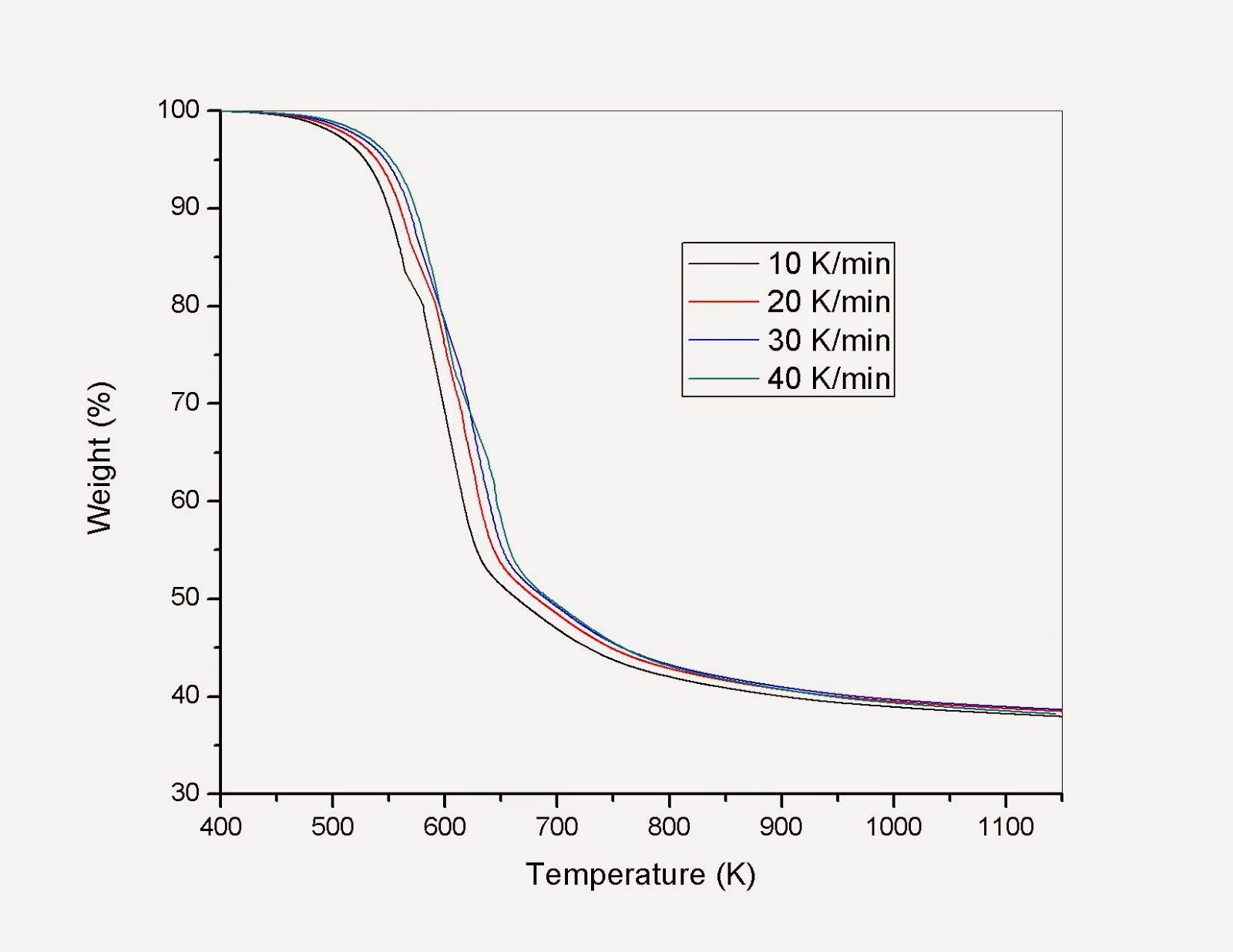
Pyrolysis was carried out at non-isothermal conditions. TGA data was taken at different heating rates as 10 20, 30, and 40 K/min in the temperature range of 383–1123 K at the end of the heating process, isothermal mode was set for 10 min to ensure that the process is completed. Typical thermo-gravimetric behavior of biomass decomposition is shown in Figure 2. From the figure 2, it is observed that, the thermal decomposition starts at approximately 500 K, following a major loss of weight at 630 K. 


Figure 2 TGA profiles of different biomass at 20 K/min.

Figure 2 shows the pyrolysis profiles of different biomass with temperature. It is observed from figure that pyrolysis rates for different biomass is different, this can be explained using the mineral content in ash of biomass and specifically potassium in form oxide acts as catalyst for biomass pyrolysis. The K2O of corncob, cotton stalk, groundnut shell and rice husk is 44.81%, 15.84%, 10.70% and 1.75% respectively. These results are in-line with Raveendran et al. (1995) [4].


Figure 3. Pyrolysis profiles of different biomass. 

Profiles in Figure 3 indicate that the pyrolysis of biomass depends on the heating rate. As heating rate increases pyrolysis rate decreases, due thermal conductivity of the biomass particle.

Conclusions 


Thermo-gravimetric studies show that each kind of biomass has unique pyrolysis characteristics, by virtue of the specific proportions of the components present in it. The influence of ash, specifically K2O on pyrolysis rate has studied. 


References 


[1] C. Di Blasi, “Modeling chemical and physical processes of wood and biomass pyrolysis,” Prog. energy Combust. Sci., vol. 34, pp. 47–90, 2008. 

[2] Y. Haseli, J. A. Van Oijen, and L. P. H. De Goey, “Modeling biomass particle pyrolysis with temperature-dependent heat of reactions,” J. Anal. Appl. Pyrolysis, vol. 90, no. 2, pp. 140–154, 2011. 

[3] X. Zhang, M. Xu, R. Sun, and L. Sun, “Study on Biomass Pyrolysis Kinetics,” J. Eng. Gas Turbines Power, vol. 128, no. 3, p. 493, 2006. 

[4] K. Raveendran, A. Ganesh, and K. C. Khilar, “Influence of mineral matter pyrolysis characteristics on biomass,” fuel, vol. 74, no. 12, pp. 1812–1822, 1995.

Sunday, September 7, 2014

Charaterisation of wood Pyrolysis oil

This part describes an analytical approach to determine the physico-chemical composition of bio-oil.

With declining petroleum resource and more concerns on environment and climate, the development for renewable energy is getting more necessary. Substantial research is being carried out within the field of energy in order to find alternative fuels to replace fossil fuels. The optimal solution would be renewable energy resource which is equivalent to the fuel which is sustainable and will decrease the CO2 emission.

Biomass derived fuels could be the prospective fuels of tomorrow as these can be produced within a relatively short cycle and are considered benign for the environment. Biomass derived fuel is pyrolysis oil which is renewable liquid fuel which can be directly used for burning in boilers, readily stored, transported, retrofitting, and flexibility in production and marketing of chemicals.

It is important to characterize the bio-oil as every bio-oil has different composition, depending on its source and pyrolysis conditions. We have used various characterization techniques to characterize the bio-oil. Physical characterization was done by the measurement of viscosity, density, higher heating value, moisture content and pH. GC-MS was used to identify the different chemical composition. Fourier Transform Infra-Red Spectroscopy was used to identify the functional groups. 


Bio-oil obtained from vacuum pyrolysis of wood at 773 K at heating rate of 30 K/min is usually dark brown free-flowing liquid having a distinctive smoky odor. The physical properties of the bio-oil are resultant of chemical composition of the liquid which is significantly different from petroleum-derived oil. Bio-oil is a complex mixture of more than 300 compounds resulting from the depolymerization of biomass building blocks cellulose, hemi-cellulose and lignin. Bio-oil is differ from petroleum based fuels both is physical and chemical composition. Bio-oil is highly polar containing about 40-50 wt% oxygen resulting in low calorific value. This liquid is acidic in nature and unstable when heated, especially in air tends to polymerize i.e increases viscosity. Bio-oil typically contains high moisture and micron size char particles which insoluble with petroleum based fuels.

The chemical composition of bio-oils is very complex, mainly composed of water, organics and a small amount of ash. It is globally represented as: around 20 % water, around 40 % GC-detectable compounds, around 15 % non-volatile HPLC detectable compounds and around 15 % high molar mass non-detectable compounds. A complete analysis of bio-oils requires the combined use of more than one analytical technique. A precise description of bio-oil composition has not yet been achieved. The accuracy of some of these analytical techniques has been highlighted in Round Robin tests conducted by different laboratories.

Table 1. Describes the physical properties of crude bio-oil obtained from waste wood.
Physical Properties
Values
Moisture content (wt %)
26.36
pH
2.80
Density (kg m-3)
1.08
Ash (wt %)
0.03
HHV (MJ kg-1)
22.20
Viscosity (cP) at T=313K
73.62
Elemental composition (wt %)
Carbon
50.92
Hydrogen
8.27
Oxygen (by difference)
38.57
Nitrogen
2.23


The chemical characterization of crude bio-oil includes GC/MS procedure followed to obtained bio-oil fractions using column chromatography eluted using different polarities of solvents.

n-Hexane Fractionation
Phenol, 4-methyl
2-Pyridinemethanol
Phenol, 2,4-dimethyl
Phenol,2-methoxy-4-methyl
Phenol- 4-ethyl-2-methoxy-
Phenol, 2,6-dimethoxy
1,2,4-trimethoxybenzene
Phenol, 2-methoxy-4-(1-propenyl)-
5-tert-butylpyrogallol or 5-tert-Butyl-1,2,3-trihydroxybenzene
Phenol,2,6-dimthoxy-4-(2-propenyl)-
DCM Fractionation compounds
2-cyclopenten-1-one, 2-hydroxy-3-methyl
phenol, 2-methoxy-
phenol, 2-methoxy-4-methyl-
phenol, 4-ethyl-2-methoxy
phenol, 2,6-dimethoxy-
1,2,4-trimethoxybenzene
5-tert-butylpyrogallol or 5-tert-Butyl-1,2,3-trihydroxybenzene
phenol,2,6-dimethoxy-4-(2-propenyl)-
Desaspidinol or 1-(2,6-Dihydroxy-4-methoxyphenyl)-1-butanone
1,3-Benzodioxol-5-yl-1-oxo-2,4-pentadienyl-piperidine
Benzene Fractionation
2-cyclopenten-1-one, 2-hydroxy-3-methyl
Phenol, 4-methyl
Phenol, 2-methoxy-
Phenol, 2-methoxy-4-methyl
Phenol, 4-ethyl-2-methoxy-
Phenol, 2,6-dimethoxy
1,2,4-trimethoxybenzene
5-tert-butylpyrogallol or 5-tert-Butyl-1,2,3-trihydroxybenzene
Phenol,2,6-dimthoxy-4-(2-propenyl)-
1,3-Benzodioxol-5-yl-1-oxo-2,4-pentadienyl-piperidine
Ethyl Acetate Fractionation
Phenol, 2-methoxy-4-methyl
1,2-Benzenediol, 3-methoxy-
Phenol, 4-ethyl-2-methoxy-
Phenol, 2,6-dimethoxy
Dehydroacetic acid
5-tert-Butylpyrogallol
Phenol, 2,6-dimethoxy-4-(2-propenyl)-
Ethanone, 1-(4-hydroxy-3,5-dimethoxyphenyl)-
Desaspidinol or 1-(2,6-Dihydroxy-4-methoxyphenyl)-1-butanone
Methanol Fractionation
Benzoic acid
1,2-Benzenediol
Phenol 2,6-dimethoxy
2-propenooic acid, 1,7,7-trimethylbicyclo[2.2.1]hept-2-yl ester,exo
1,2,3-Trimethoxybenzene
1,6-anhydro-beta-d-glucopyranose
5-tert-Butylpyrogallol
Phenol 2,6-dimethoxy-4-(2-propenyl)-
Ethanone 1-(4-hydroxy-3,5-dimethoxyphenyl)-
Desapodinol
4H-1-Benzopyran-4-one,2-(3,4-dimethoxyphenyl)-7-hydroxy-3-methoxy-
Benzaldehye, 4-hydroxy-3,5-dimethoxy-
10,11-dihydro-10-hydroxy-2,3,6-trimethoxydibenz(b,f)oxepin
Benzene,1,1',1'',1'''-(1,6-hexanediylidene)tetrakis- (9CI)

Determination of functional groups of pyrolysis oil

The pyrolysis oil of wood obtained was analysed for its functional group composition using Fourier Transform Infra-Red Spectroscopy (FTIR). The system used was a Bunker`s Tensor 27 series with an on-line pen plotter to produce the IR-spectra of the derived liquid. It provides the absorbance spectra units along the wave number 4000 to 500 cm-1

Figure 1 below shows the absorbance unit vs. IR frequency of crude bio-oil.


GHOKE PRAVEEN..

Friday, August 15, 2014

Happy Independence Day.

Today people from around the world celebrating the 68th Indian Independence Day. This is from side...
Carried with care, coated with pride,
Dipped in love, fly in glory,
Moments of freedom in shade of joy.
Proud to be an Indian, Happy Independence.

Monday, August 4, 2014

Biomass charaterisation

Biomass is very much different from biomass produce from different places. Charaterisation of biomass very important to get best possible processing strategy for production of range of fuels, also to understand how easy is it to produce, collect, store, transport, and process (crop yield, economics, equipment availability, grinding performance, etc.). 

To charaterise the biomass, we need study the combustion properties of biomass which includes that all properties of biomass.


Combustion properties of biomass:


Biomass to Bio-fuels

Biomass is abundantly available bio-fuel which is considered as carbon neutral i.e,. carbon absorbed from the atmosphere by biomass(plants) and release to the atmosphere when they burned. Hence there is no net addition of carbon added to the atmosphere. 

What is Biomass?


There are different meaning of biomass; Biologically, Biomass can be defined as Carbon based mixture of organic molecules also contains hydrogen and oxygen. Element Nitrogen based on the type of biomass and small quantities of metals and alkali, alkaline earth atoms.

Biomass is wood products, dried vegetation, crop residue, aquatic plants and even garbage. These are all natural materials; uses sun's energy to make food and store in form of chemical energy. This trapped energy is released when we process through specific conversion method. The released energy is called as BioEnergy..

Biomass is renewable source of fuel to produce BioEnergy.

Biomass Conversion process:

Sunday, August 3, 2014

The defense of your thesis

Here is how the concluding part of your research effort should be handled. 

SUCCESSFUL COMPLETION: In the final analysis, your thesis should be complete in all essential respects.  

 "The best thesis is a done thesis!"
 
The all-important stage is the one where you make your `defense' of the thesis. This is no war where a group of experts are ranged against the solitary researcher. Never take it as a defense, but just a presentation of your ideas over which you have given your deepest thought during the past few years. You are sure of all the diverse aspects of the topic, perhaps far better than the members of the jury before you. Your objective is to convince your audience that you have done your job well, your methodology is sound and the findings are useful. In experimental topics, all your important findings should be based on repeated experiments which should be repeatable by anyone else.

Art of writing a thesis

On the approach that is required in writing a research thesis. 

GET IT RIGHT: Get a grounding of the writing basics before you start putting together your thesis.  

Write to be understood, speak to be heard, read to grow. Lawrence Clark Powell, American Writer

WHILE ENJOYING highly readable text, we are not aware of the pains the writer underwent in preparing it. The right choice of words is not an easy task. The richer one's vocabulary, the tougher the task is. None would appreciate you, if you delude yourself into believing that long words or complex construction would impress the readers. Never attempt grandiloquence in a thesis.

Clarity

Whether it is a simple note, a dissertation or a thesis, or any other writing for that matter, it fails in its function if the target readers do not get the message with clarity and ease. Confused thinking will lead to woolly writing. If you have not understood your point well and state it ambiguously, another person who reads it will never get the point. Your expression has to be precise. None would admire or even relish a bundle of vagueness, when looking for accurate information in a new area of knowledge. Clear and effective presentation of ideas is more important than anything else.

Since a thesis is a document to be checked and assessed by experts in the line, avoid expressions such as "In other words" and "To put it in a simpler way." Experts may not take kindly to such phrases, as they feel that they are competent to grasp even complex ideas couched in difficult idiom.